The Real Cost of a Missed Clinic Call in Ghana — And Why It's Bigger Than You Think
Research published in peer-reviewed medical literature puts the average cost of a single missed appointment at $196 per no-show. At current exchange rates, that translates to over GHS 2,500 per empty appointment slot.
It starts with a simple phone call. A woman in Tema finishes her shift at 6:15pm, finally free to do the one thing she has been putting off all week. She picks up her phone and dials the number of a private clinic she found online. It rings. And rings. And rings. No one answers. She waits a few minutes and tries again. Still nothing. She looks at the time, scrolls through her contacts, and calls her neighbour who mentioned a different clinic last month. By 6:30pm, she has booked elsewhere. The first clinic never knew she called. Never knew she left. Never knew she would not be back. This scenario plays out dozens of times every single day in private clinics, dental practices, specialist centres, and hospitals across Ghana. It is one of the most expensive problems in Ghanaian healthcare — and it remains almost entirely invisible because no one is counting the calls that were never answered.
The Numbers Nobody Talks About
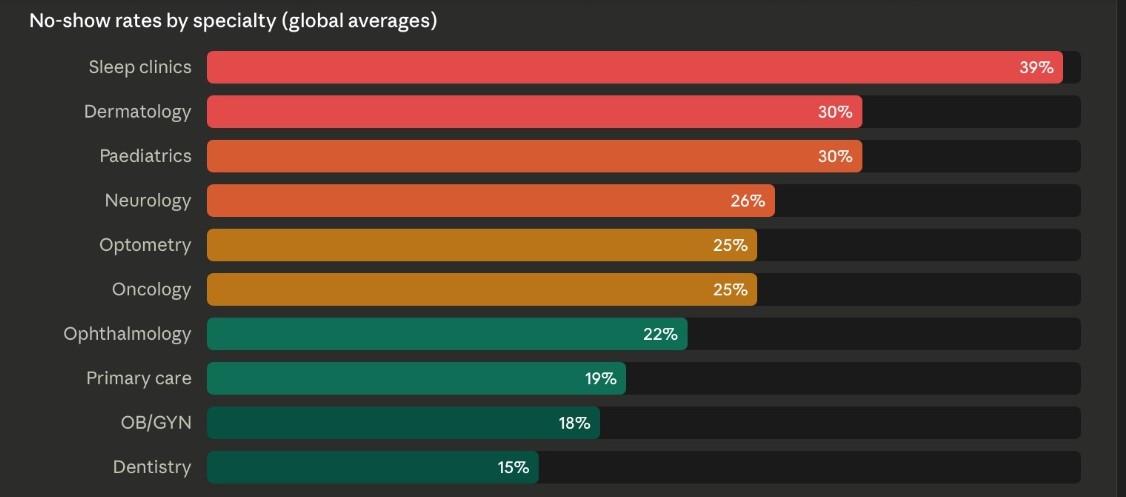
Ask any clinic administrator how many patients they saw last week, and they will tell you. Ask them how many calls went unanswered after 5pm, on Saturday afternoon, or during the two hours their receptionist was managing a complicated check-in, and most will have no answer at all. That silence is the problem. Globally, the average appointment no-show rate across healthcare settings sits at 23.5% — meaning nearly one in four scheduled appointments simply does not happen. In Africa, and particularly in urban West African settings, rates can climb significantly higher. A study in one of the largest radiology departments in the MENA region found no-show rates ranging from 10% for simple procedures to over 80% for specialist scans. A South African regional hospital reported non-attendance rates of up to 40% across its outpatient clinics. Ghana is not insulated from this. With over 10,000 registered health facilities in the country — including more than 1,360 private facilities and 200 private hospitals — and a patient population that relies almost entirely on phone calls to book, reschedule, and enquire, the communication gap is enormous. Now here is the part that makes clinic CEOs sit up.
What a Single Missed Call Actually Costs
Let us do the maths for a mid-sized private clinic in Accra. Private clinic consultation fees in Ghana now typically range from GHS 150 to GHS 300 per visit. A dental appointment, specialist consultation, or diagnostic review can run considerably higher. For our example, let us use a conservative GHS 200 per patient visit. If a clinic receives just 20 unanswered calls per week — and many receive far more — and converts even half of those callers into patients under normal circumstances, that is 10 lost appointments per week. At GHS 200 per visit:
Weekly revenue loss: GHS 2,000
Monthly revenue loss: GHS 8,000
Annual revenue loss: GHS 96,000 — nearly GHS 100,000 every year
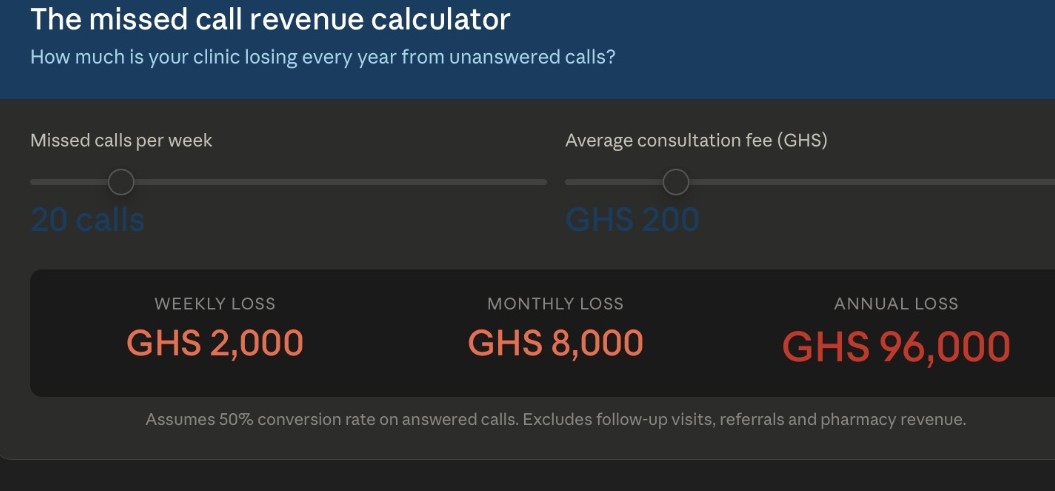
And that is the conservative estimate. It does not include the follow-up tests, pharmacy sales, referrals, or repeat visits that never happen because the first contact was never made. It does not account for the word-of-mouth that a frustrated caller takes to their friends and family. It does not count the Google review they leave, or do not leave, because the experience was simply the sound of a phone ringing into nothing.
"I Just Forgot" — The No-Show Epidemic
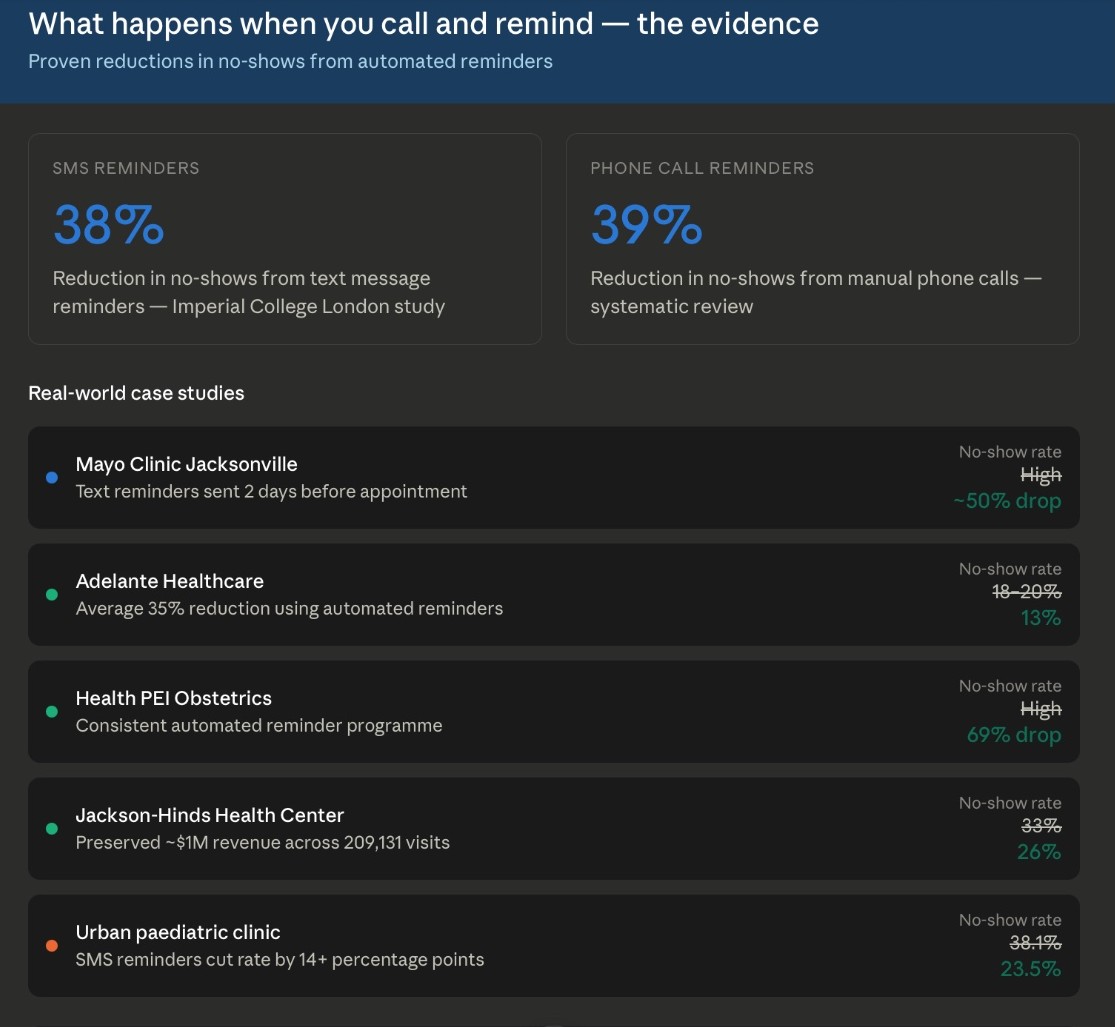
Missed appointments are not just a communication problem. They are a revenue haemorrhage that bleeds slowly and silently. Research published in peer-reviewed medical literature puts the average cost of a single missed appointment at $196 per no-show. At current exchange rates, that translates to over GHS 2,500 per empty appointment slot. Across an independent practice, the annual revenue loss from no-shows alone has been estimated at $150,000 — or roughly GHS 1.9 million per year. Even at a fraction of that scale, the numbers are staggering for a Ghanaian private clinic. The most important finding from the research on why patients miss appointments? It is rarely negligence. In the majority of cases, patients simply forgot. A systematic review found that appointment reminders using SMS text messages reduced no-show rates by 38%. A children's clinic in an urban setting saw its no-show rate fall from 38.1% to 23.5% after implementing SMS reminders — a drop of more than 14 percentage points simply by sending a message. A healthcare network called Adelante reduced its no-show rate by 35% through automated reminders, bringing it from 18–20% down to 13%. Health PEI's obstetrics clinic achieved a 69% decrease in no-shows through consistent reminder messages. The intervention is not complicated. The cost is low. The return is enormous. But most Ghanaian clinics are still doing it manually — or not doing it at all.
The Receptionist Cannot Be Everywhere
Here is a truth every clinic administrator in Ghana knows but rarely says out loud: the receptionist is the most overworked person in the building. In a typical private clinic, one or two front desk staff are simultaneously checking patients in, managing paper files, answering the phone, handling billing questions, explaining directions to new patients, managing the waiting room queue, and relaying messages to doctors. On a busy Monday morning or a full Friday afternoon, something inevitably falls through the cracks. That something is almost always the phone. A caller who reaches a busy tone or a receptionist who sounds distracted and rushed does not feel valued. Studies consistently show that patient experience begins at the very first contact — not at the consultation room door, but at the moment they first try to reach you. If that moment is frustrating, inconvenient, or unsuccessful, the patient's perception of the clinic is already coloured before they ever walk through the door.
The problem intensifies after hours. Ghana's working population largely cannot make personal phone calls during office hours. They call during lunch breaks, from their cars at 6pm, or on Sunday evenings when they remember to book that appointment they have been putting off. Those are precisely the hours when clinics are closed and phones are unmanned. Every call that goes unanswered during those hours is a guaranteed missed booking.
The Patient's Side of the Story
We often measure this problem from the clinic's perspective — the lost revenue, the empty appointment slots, the wasted clinical capacity. But the cost to the patient is just as real, and in the Ghanaian healthcare context, often more serious.
Ghana has approximately 4,300 doctors for a population of over 33 million people — a ratio of roughly one doctor per 7,700 people. Access to quality healthcare is not easy. When a patient calls a clinic and cannot get through, they do not simply reschedule at their convenience. Many delay entirely. Conditions that would have been caught early at a routine consultation are missed. Chronic conditions — hypertension, diabetes, cancers — go unmonitored. The patient who called at 6:15pm and did not get through may not try again for weeks.
The World Health Organisation has consistently documented that poor patient communication is a key driver of delayed care-seeking in Sub-Saharan Africa. The barriers are not just physical or financial. A significant proportion of delayed care is explained by a simple failure of availability — the patient tried, could not reach anyone, and gave up.
In a country where Ghana projects to spend over GHS 17.8 billion on health in 2025 — a 13.4% increase on the previous year — the government is investing heavily in healthcare access. The irony is that a significant portion of that investment in capacity, staff, and infrastructure is undermined at the very first touchpoint: the unanswered phone call.
After the Call — The Follow-Up Gap
Even when a clinic successfully brings a patient in, the relationship frequently ends the moment they walk out of the door. No follow-up call to check recovery after a procedure. No reminder for a six-month dental check-up. No proactive outreach to a diabetic patient due for their quarterly review. No feedback request to find out whether the experience was good or whether there were problems that quietly drove a patient away for good. This is the second phase of the missed call problem — the calls that were never made in the first place. Healthcare businesses that follow up with patients post-visit see measurably better outcomes on every dimension: patient retention, repeat visit rates, referral generation, and online reputation. The research is unambiguous. Yet across Ghana's private healthcare sector, systematic follow-up remains the exception rather than the rule — not because clinics do not care, but because the infrastructure to do it reliably and at scale simply does not exist for most facilities. A receptionist with 30 patients to manage cannot also call 50 previous patients to check how they are doing. The math does not work. So the calls do not happen, and the relationship fades.
What the Technology Can Do
The good news — and it is significant — is that this is one of the most solvable problems in healthcare management. Automated appointment reminders delivered by voice or SMS have been proven to cut no-show rates by 20% to 38% across dozens of clinical studies. The Mayo Clinic's Jacksonville facility achieved a nearly 50% drop in no-shows by sending automated text reminders two days before appointments. Jackson-Hinds Community Health Center reduced its no-show rate from 33% to 26% across more than 200,000 scheduled visits — preserving nearly $1 million in revenue without adding a single staff member. Text messages have a 98% open rate. A phone call goes to voicemail. An SMS arrives on a patient's lock screen and is seen within minutes. 84% of patients say they are more likely to attend an appointment if they receive a reminder message.
Voice AI is the natural extension of this for the Ghanaian market, where phone calls remain the primary and most trusted form of communication. An AI receptionist that answers every call — at 6am, at 10pm, on Saturday, on a public holiday — removes the single biggest barrier between a patient's intention to seek care and their actual arrival at the clinic. And proactive outbound calling — the AI that calls patients before they need to think about calling the clinic — is the closest thing to a guaranteed retention strategy that healthcare has ever seen.
What This Means for You
If you are a patient: The next time you call a clinic and no one answers, know that the system has failed you — not the other way around. You should never have to wonder whether your clinic cares about you between visits. You should receive a reminder before your appointment. You should get a follow-up call after your procedure. You deserve that. And it is entirely possible.
If you are a clinic administrator or practice manager: Run this calculation for your own facility. How many calls come in after 5pm? How many go unanswered on weekends? What is your no-show rate, and what is that costing you per month? The numbers, once you see them, are rarely comfortable. But they are fixable.
If you are a hospital CEO or medical director: Patient communication is not a soft problem. It is a revenue problem, a retention problem, and a care quality problem simultaneously. Every unanswered call, every missed reminder, every patient who leaves and never comes back represents a quantifiable cost to your institution — and a missed opportunity to deliver the care your team is trained and ready to provide.
The phone ringing into silence is not a minor operational inconvenience. It is the loudest sound in modern healthcare — because it is the sound of a patient giving up.
The Bottom Line
Ghana's healthcare sector is growing, investing, and improving. The infrastructure is being built. The clinical talent is being trained. The government is spending at record levels. But for many patients, the healthcare system still begins and ends with a phone call. If that call goes unanswered — at any hour, for any reason — the investment in everything else is worth less than it should be. The real cost of a missed clinic call is not just the GHS 200 consultation fee. It is the relationship that never started, the condition that went undiagnosed, the patient who told three friends to go elsewhere, and the revenue that was never on the books to lose.
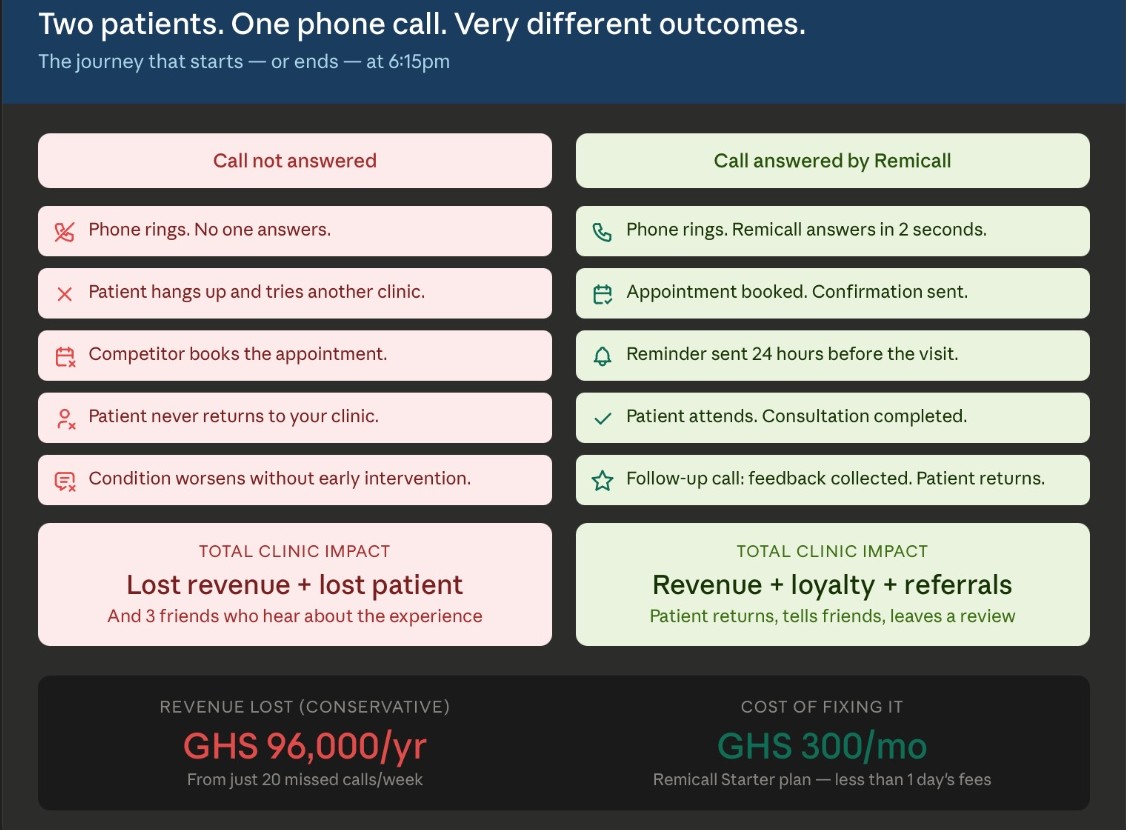
The fix is not complicated. It is not expensive. And for clinics in Ghana that implement it, the results show up immediately — in appointment books, in revenue reports, and in the simple, meaningful fact that every patient who calls actually gets an answer.
Remicall is a Voice AI agent helping Ghanaian healthcare providers answer every patient call — 24 hours a day, 7 days a week. To learn more or book a demo, visit www.remicall.com or email support@remicall.com.
Sources: Ghana Ministry of Health & Ghana Health Service (2023); US Trade.gov Ghana Healthcare Country Guide (2026); Dialog Health Patient No-Show Statistics (2025); Prospyr Medical, How No-Show Rates Impact Revenue (2026); Klara, Text Appointment Reminders Study, Imperial College London; PubMed, Prevalence, Predictors and Economic Consequences of No-Shows (PMC4714455); RingRx, Text Message Reminders Reduce Healthcare No-Shows (2026); African Journal of Primary Health Care & Family Medicine, George Hospital South Africa No-Show Study; Pabau, How to Calculate and Reduce Patient No-Show Rate (2024); Statista / Ministry of Health Ghana, Number of Health Facilities by Ownership (2023); Severe Malaria Observatory, Ghana Malaria Cases 2023; NHIS Ghana enrollment data (2025).